
Corner Guards Help
Everything you need to choose the right model and the right size — the options explained, how we build your order, and why you should never cut metal corner guards on the jobsite.
Options Definitions
Six models cover almost every condition. Measure the leg width (side) and the height you need, then pick the profile.
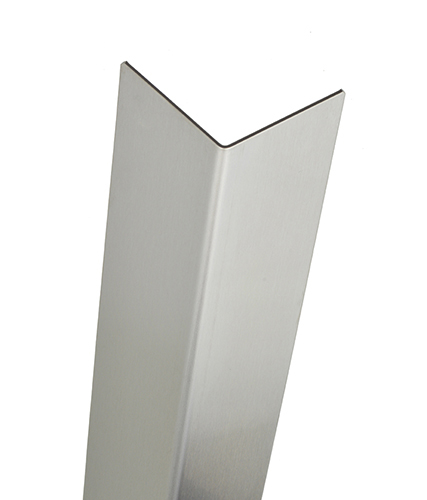
Basic Metal Corner Guard
90° corner guards with no wings and no holes. Our most common model.
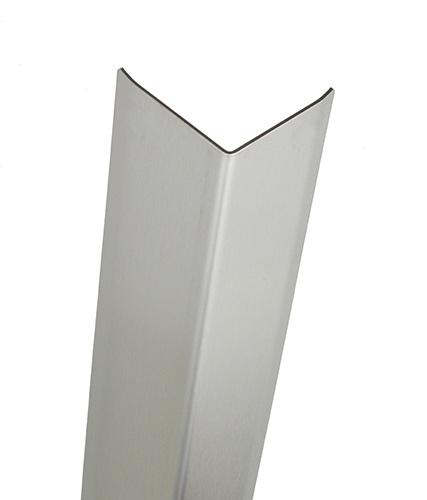
Corner Guard with Wings
Sometimes called “huggers.” Wings are a slight bend roughly 3/8" in from the side edges.
Winged models don't sit as flush as the basic model — expect about a 1/16" gap at the top, which can be sealed with a bead of silicone. Ideal for hiding imperfections in the angle of the corner, and they give the guard a classier look.
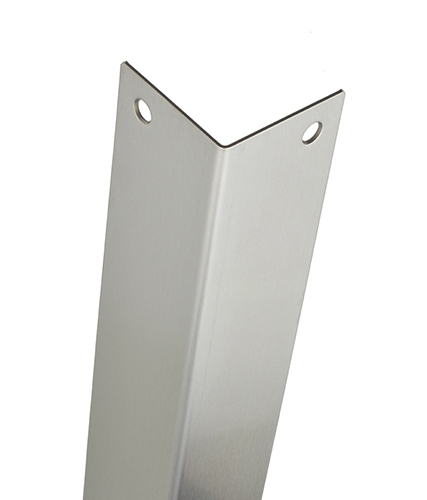
Corner Guard with Holes
Predrilled countersunk holes. #8 stainless steel screws are supplied.
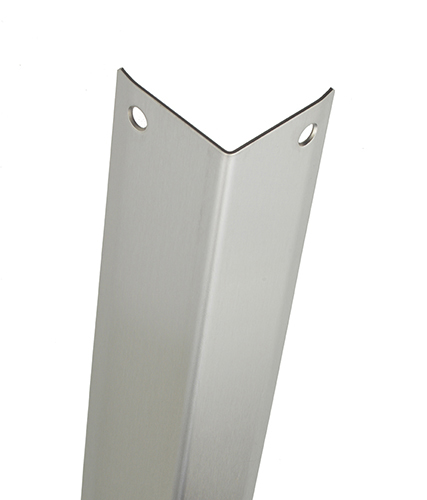
Corner Guard with Wings & Holes
Both features combined — 3/8" wings plus predrilled countersunk holes. #8 stainless steel screws are supplied.
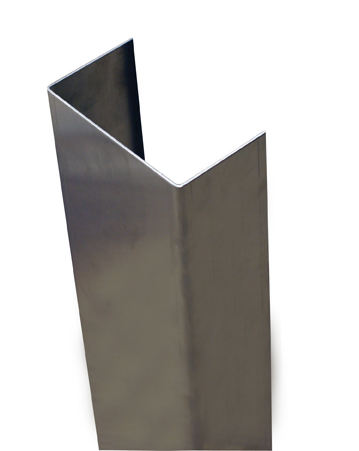
U-Channel / End Wall Cap
U-shaped guards designed to wrap around end caps or columns. Measured by side width and ID (inside dimension).
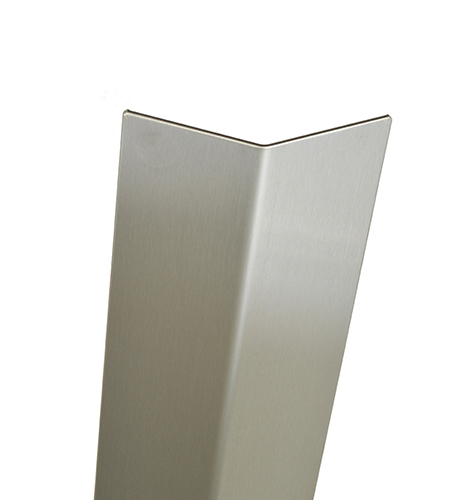
135° Basic Corner Guard
135° corner guards with no wings and no holes — for obtuse corners.
Stock, Lead Times & Custom Sizes
We are a manufacturer, not a warehouse. That changes what you should order.
Stock
It is important to understand that we do not stock any sizes. If you need your metal corner guard “tomorrow,” we have only a very select few sizes and options available.
We custom make every order just in time, and we have it down to a science. Using Six Sigma and Lean Manufacturing principles, your order is handed to the one person who will build it start to finish — whether it's 1 corner guard or 500.
Short Lead Times
Typically an order ships within 24 to 72 hours, depending on the size of the order.
That's build time, not delivery time. Add FedEx transit on top — see the map below.
Custom Sizes
Make sure to order the correct size and model. Because of our short lead time philosophy, we can make any size you need — and custom-length cuts are free on all metal products.
If you need heights or sides that aren't in our standard models, please call. It is much easier for us to make a guard that is 47 3/4" during manufacturing than for you to cut a 48" guard down to size on site.
We can also do: non-standard angles · leg widths down to 1/2" · gauges from 7 ga to 20 ga · prepunched mounting patterns. Almost any height is available; heights over 10 feet require welding and polishing.
Transit Time After It Ships
The 24 to 72 hours above is manufacturing time. Transit is on top of that. We ship metal corner guards via FedEx Ground from our metal shop in Minneapolis, MN — the map shows business days in transit once the order leaves the building.
So a guard ordered Monday and built in 48 hours leaves Wednesday, then adds the transit days shown for your state.
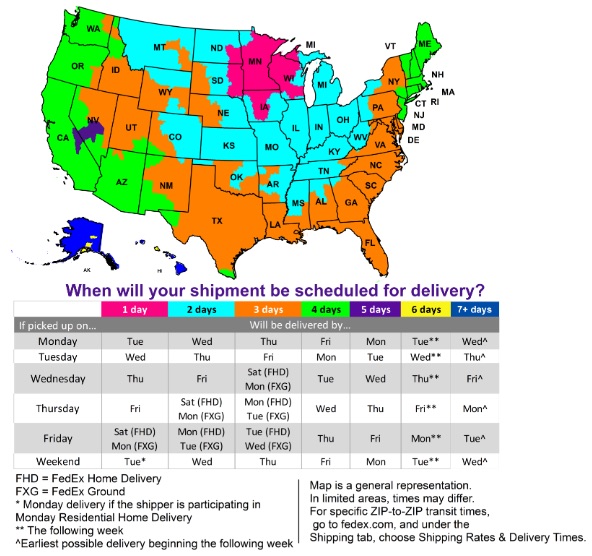
This map covers metal products. Vinyl, polycarbonate and rubber lines ship from different plants and have their own maps — and InPro products still ship UPS.
Transit days are FedEx estimates, not guarantees, and exclude weekends and holidays. Shipping to Canada requires that you have your own customs broker.
Don't Cut Stainless Steel in the Field
The single most common and most expensive mistake made with metal corner guards.
The short version: Stainless steel work-hardens the instant a dull tool touches it, holds heat at the cut instead of shedding it, and shows every mistake permanently in the finish. On a jobsite you have none of the three things that make a clean cut possible — rigid clamping, a stainless-dedicated blade, and a way to restore a #4 satin grain afterward.
Give us the finished dimension and we'll cut it during manufacturing. Custom length cuts are free on all metal products.
Why it goes wrong
It gets harder the more you cut it
Types 304 and 316 are austenitic stainless. Deforming them work-hardens the metal locally, so the act of cutting makes the material ahead of your blade harder than what you started with. A dull tooth rubs instead of cutting, rubbing hardens the surface, and the blade dulls faster — a loop that's almost impossible to escape. Easing off the pressure is exactly the wrong instinct.
It won't let go of heat
Type 304 conducts heat at roughly 16 W/m·K — about a third as well as carbon steel and a twelfth as well as aluminum. The heat has nowhere to go, so it concentrates at the cut and pours into your blade. Blades lose their temper, abrasive wheels glaze, and the guard itself gets hot enough to change permanently.
Heat tint doesn't buff out
That straw-to-blue-to-purple band alongside the cut is a thickened oxide layer, not soot. Cosmetically it's a permanent stain on architectural metal. Functionally it's worse: it disrupts the chromium passive layer, so the tinted zone is measurably less corrosion resistant. In a washdown area, that scorched band is where rust starts.
The wrong blade makes your stainless rust
Cut with a blade, wheel, or wire brush that has touched carbon steel and you embed microscopic iron particles in the surface. Six weeks later there's a rash of orange freckles along the cut edge of a brand-new guard. That's cross-contamination, not the wrong grade — and spark spatter does the same to every finished surface nearby.
A #4 finish can't be repaired on site
A #4 satin finish is a uniform directional grain applied under constant pressure on a wide-belt machine. A hand sander or flap disc gets close, and close is the problem — the eye picks up any change in grain direction, grit, or gloss. A #8 mirror finish has no field version at all. Corner guards are viewed edge-on down a corridor, the most unforgiving sightline there is.
It's an angle, not a flat bar
You're cutting two legs at once, across the radius at the bend, so tool engagement changes constantly — exactly when a blade grabs. Thin-gauge formed angle is springy: an unsupported leg deflects, pinches the blade, and kicks back. There's no flat face to clamp without marring the finish. Self-stick tape gums the blade on top of all that.
The burr is a liability
A cut edge in stainless leaves a burr that is thin, hard, and work-hardened into something closer to a blade than a rough edge — mounted at hand height in hospital corridors, school hallways, and commercial kitchens. A factory cut is deburred and eased as a matter of course.
Square matters more than you'd think
Cut a 4-foot guard one degree out of square and the far end is off by about an eighth of an inch. Where the cut end butts a ceiling line, a base, or another guard, that eighth inch becomes a tapered wedge of shadow. And you only get one attempt — you can always take more off, but you can't put it back.
What actually happens with each tool
If you're going to do it anyway, at least start with the right tool.
| Tool | What happens | Verdict |
|---|---|---|
| Abrasive chop saw / cutoff wheel | Fastest and worst. Maximum heat, heavy tint, spark shower that embeds in nearby finishes. Contaminates unless the wheel is stainless-specific. | Avoid |
| Angle grinder, thin cutoff wheel | Same heat and contamination problems, plus almost impossible to hold a straight line across a formed angle. | Emergency only |
| Circular saw, abrasive wheel | Heat, binding, and real kickback risk on springy thin-gauge angle. | Avoid |
| Aviation snips | Deforms and curls the leg. Fine for rough sheet, not for a finished profile. | Avoid on finished work |
| Nibbler or throatless shear | No heat, no sparks, no tint. Leaves a rough edge that needs dressing. Good for notching around obstructions. | Workable |
| Portable bandsaw, bimetal 18–24 TPI | Slow, cool, controllable, minimal tint. The best balance of speed and finish control on site. | Good |
| Hacksaw, 24–32 TPI bimetal | Slowest, coolest, most controllable. Perfectly adequate for one or two cuts. | Good |
| Cold-cut saw, carbide-tooth metal blade | Low RPM, big chip, cool cut, clean edge. The correct power tool — if you have a stainless-dedicated blade for it. | Best power option |
If you absolutely have to cut it on site
Sometimes the wall isn't where the drawing said it was. If you're stuck, do it this way.
- Use a stainless-dedicated blade. Never one that has touched carbon steel. This is the single easiest way to prevent rust spots later.
- Mask the finish. Painter's tape on both sides of the cut line, on both legs. It protects the grain and catches spark spatter.
- Clamp it hard and back it up. Sandwich the leg between scrap wood so nothing can deflect or chatter. Most bad cuts are really clamping failures.
- Fine pitch, and angle the cut. 24–32 TPI minimum. Tilt the blade so it engages a longer sweep of material rather than hitting the thin edge square on.
- Firm, steady pressure. Low speed. Let each tooth take a chip. Rubbing is what work-hardens the material. Speed is not your friend here; pressure is.
- Use cutting fluid. It carries heat away from a material that can't carry it away on its own.
- Cut long, then file to fit. Leave 1/16" and take it down. You cannot add material back.
- Deburr along the grain. Draw the file in the direction of the brush lines, never across them.
- Clean up correctly. Stainless cleaner and a non-woven pad. Never steel wool, never a carbon-steel wire brush — both leave iron behind that will rust.
- Wear gloves and eye protection. Stainless chips are hot, needle-sharp, and they stick to skin.
For drilling: cobalt bits (M35 or M42), slow speed, heavy constant pressure, cutting oil, and do not peck — every time you back the bit out, the bottom of the hole hardens. Punch a good center mark, get through in one continuous cut, and use a step bit on thin gauge so the flutes can't grab and spin the panel.
The better answer: have it cut before it ships
In production, the cut is made on properly tooled equipment with the panel fully supported, using dedicated stainless tooling — then deburred, edge-dressed, and inspected to match the finish of the rest of the piece. It arrives ready to install. No tint, no burr, no contamination, no wedge gap.
Measure the opening. Tell us the number. Let us do the hard part.
The full article covers work hardening, heat tint, contamination, and finish repair in more depth, plus an FAQ on miter saws, plasma cutters, short trims, and self-stick tape.
More Help & Resources
If you can't find the help you need on this page, give us a call at 800-516-4036 — we'll be happy to answer any questions you have.
Ordering & Shipping
Not sure what size you need?
We've been manufacturing and shipping wall protection since 2007 — more than 170,000 orders and counting. Call us Monday through Friday, 8am–5pm CST.
Call 800-516-4036